BlackRock, Binance, Bitwise and Lombard all picked the same Bitcoin yield engine
Some of the most sophisticated names in finance looked at the problem of Bitcoin income and converged on the same mechanism. Here's how the products differ, and why LBTC stands apart.

LBTC is not a new way to generate income on Bitcoin. It's the same institutional strategy that BlackRock, Grayscale, and NEOS already sell to the public as ETFs, that Binance launched for its own users in July, and that Bitwise runs for its private clients. Some of the largest names in asset management, the largest exchange in the world, and now Goldman Sachs by acquisition: all of them sell call options against a Bitcoin position and pay the premium out as yield. LBTC draws on it too, with the strategy managed by Bitwise Investment Manager.
Nobody coordinated this. They converged, because the alternatives don't survive scrutiny.
While there are of course differences in the strategies, it's where it lives, who it serves, and what it returns that really differentiate the products. This piece explores the Bitcoin income products available in the market today, and shares: what the strategy actually is, why everyone building one arrived at it, how the existing offerings compare, and why the onchain version is the one that compounds for a Bitcoin holder.
What a covered call actually is
A covered call is one of the oldest income strategies in finance, older than Bitcoin by decades.
An investor who owns an asset sells someone else the right, not the obligation, to buy it at a fixed price (the strike) by a fixed date. The buyer pays a premium for that right. The seller keeps the premium no matter what happens, and keeps the asset too, unless its price rises above the strike, in which case the asset gets called away at that price.
Selling call options against a Bitcoin position isn't new or experimental. Large asset managers, family offices, and HNWIs have used covered-call strategies to generate income on Bitcoin holdings for years.
Why everyone picked this engine
The premium is structural, not cyclical. Options buyers systematically overpay for optionality. Implied volatility persistently exceeds realised volatility, across asset classes and across three decades. Buyers of options are paying for convexity and protection, and they are willing to pay above fair value to get it, the same way people pay for insurance.
Bitcoin is an unusually good underlying for it. Option premiums scale with volatility, and Bitcoin is materially more volatile than the equity indices where this strategy was built. The single most common complaint about Bitcoin as an asset is precisely the thing that makes it one of the best underlyings in the world for an income overlay.
The market is deep enough to run at scale. In January this year, Bitcoin options open interest hit $74.1bn, overtaking Bitcoin futures open interest for the first time. That growth is driven by large holders seeking income and downside protection over directional bets, and more recently by the flurry of covered-call ETF launches. Institutional call-overwriting flow on BTC is now large enough that market analysts credit it with dampening Bitcoin's volatility itself.
It survives diligence. Positions, greeks, and P&L are observable daily. That's why this strategy clears institutional risk committees when a yield black box doesn't, and in the specific case of LBTC it's the same reason it can be published on a public dashboard rather than described in a quarterly letter.
Double-clicking on the Bitwise strategy specifically: there is no track record like it anywhere in Bitcoin yield. Four and a half years, through every market condition, including the 2022 bear market and the recovery that followed. On a net basis: +8.30% in 2022, +3.73% in 2023, +12.83% in 2024, +6.14% in 2025, and +2.80% year to date through June 2026. Across that entire period, no Bitcoin has ever been called away from an account overseen by the strategy manager.
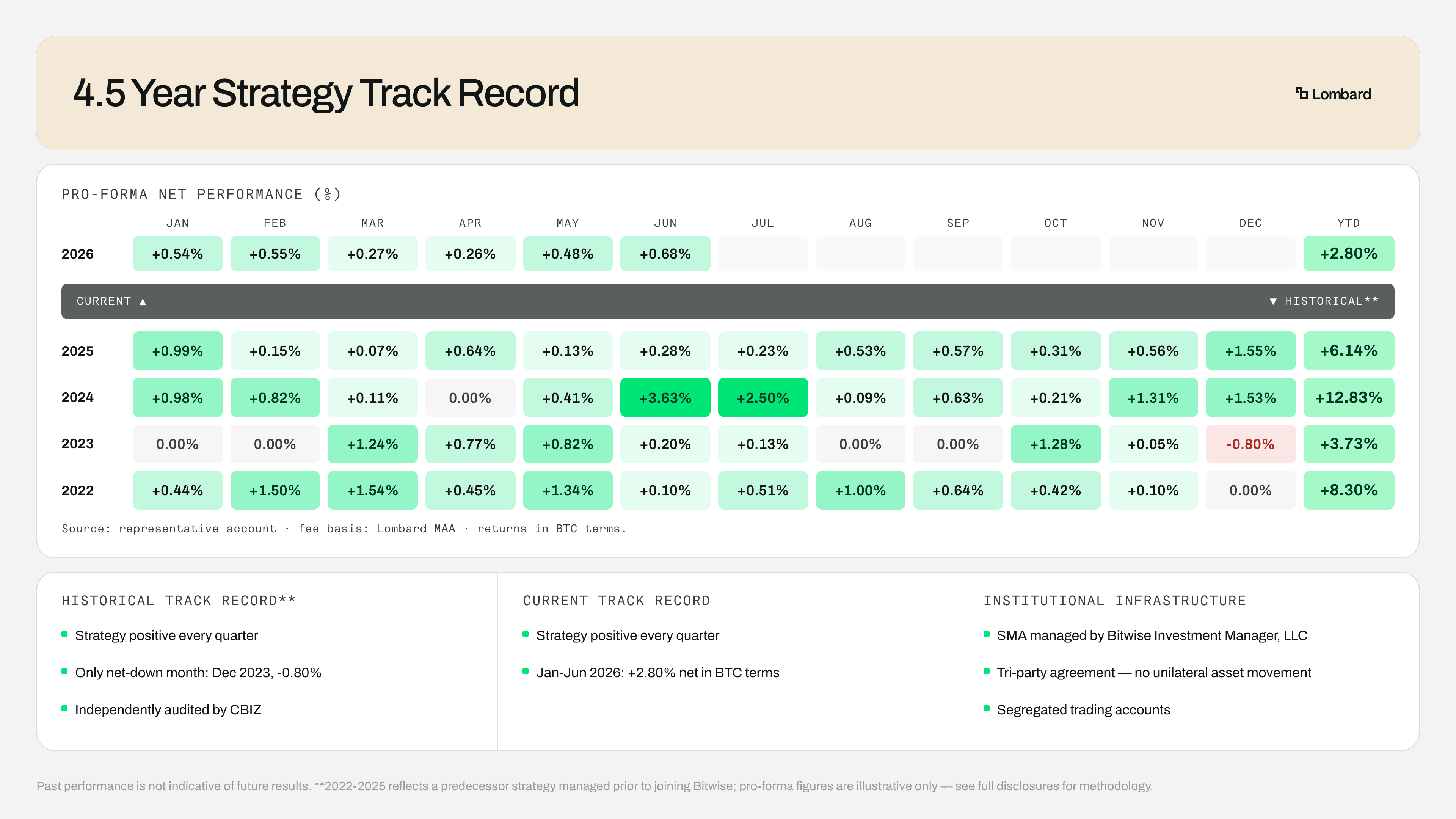 LBTC Track Record-selection.png
Past results are not necessarily indicative of future results, and there is no guarantee that the strategy will achieve its objectives or avoid substantial losses, including loss of principal.
LBTC Track Record-selection.png
Past results are not necessarily indicative of future results, and there is no guarantee that the strategy will achieve its objectives or avoid substantial losses, including loss of principal.
How the offerings compare
The table below compares the Bitcoin income products available today, including DeFi with LBTC. The strategy itself is broadly the same across every row, with two structural quirks worth noting: BITA writes calls against IBIT, BlackRock's own spot Bitcoin ETF, rather than against Bitcoin directly, and BTCI writes against Bitcoin ETPs rather than spot. Grayscale runs two versions of the same idea, BTCC writing close to spot for maximum income, BPI writing further out-of-the-money to keep more upside.
What differs is everything after the strategy: what you put in, what you get out, who can get it, and what you can do with it once you have it.
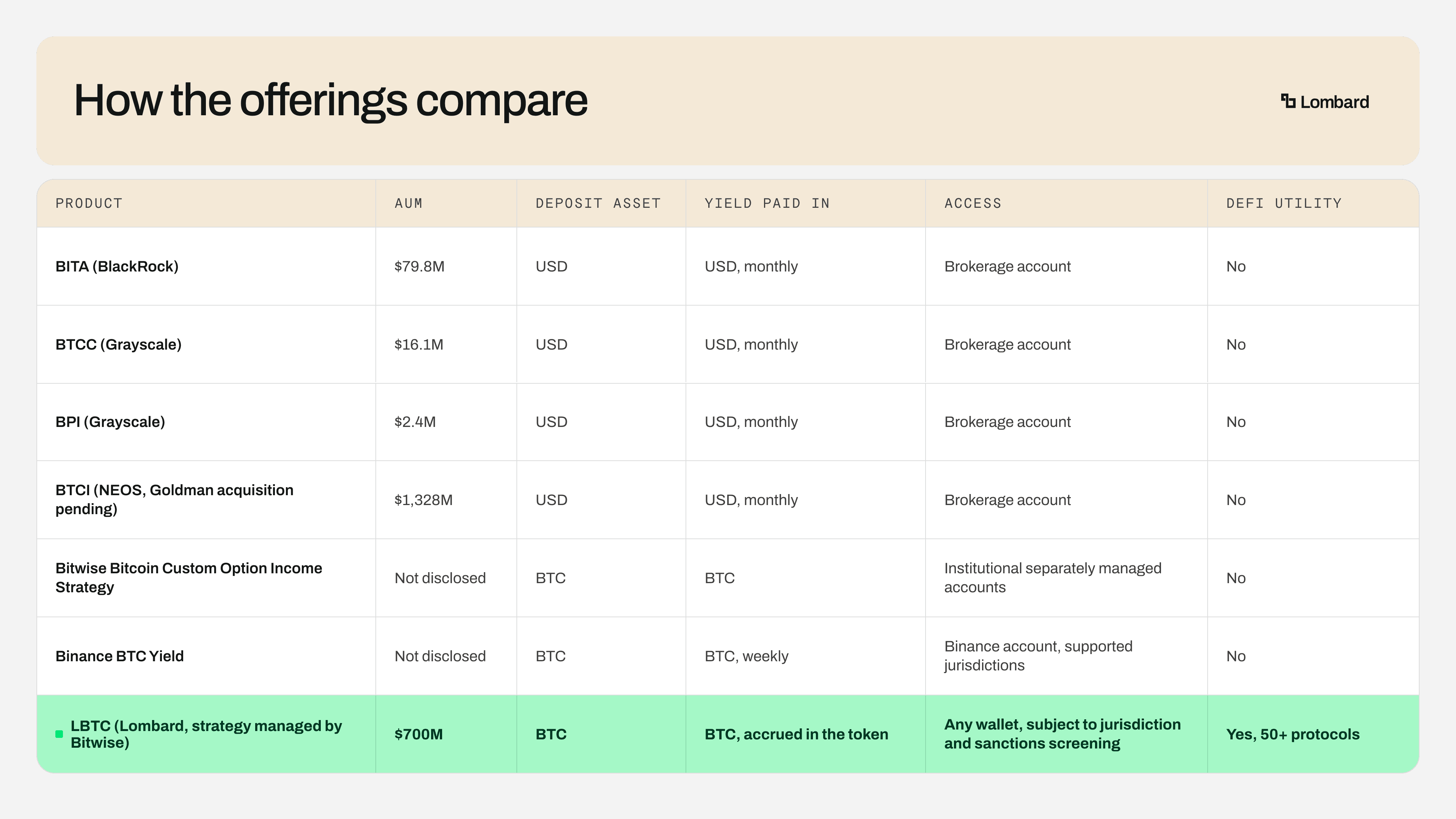 LBTC Offering Comparison-selection.png
AUM, deposit asset and distribution frequency for BITA, BTCC, BPI and BTCI: ETF Database, September 2026. Binance BTC Yield mechanics: Binance, July 2026. LBTC AUM: Lombard transparency page.
LBTC Offering Comparison-selection.png
AUM, deposit asset and distribution frequency for BITA, BTCC, BPI and BTCI: ETF Database, September 2026. Binance BTC Yield mechanics: Binance, July 2026. LBTC AUM: Lombard transparency page.
The deposit asset is the first thing that separates these products
Four of the seven require dollars. To access a Bitcoin income ETF, a Bitcoin holder has to sell Bitcoin, move dollars to a brokerage account, and buy a share. They exit their Bitcoin position in order to buy a product that earns income on Bitcoin. In most jurisdictions that sale is a disposal with tax consequences, and it is certainly a decision: the moment they sell, they are no longer long Bitcoin the way they were the day before. They are long a fund that holds some Bitcoin exposure and a lot of dollars. BITA, as of this writing, holds roughly 31% of its assets in IBIT and the remainder in cash.
The three products that accept Bitcoin directly are the ones built for people who already hold it, and each one asks for something in return. Bitwise's own strategy is an overlay on a client's existing Bitcoin, which is exactly the right design, and it is available through separately managed accounts to institutional clients. Binance accepts BTC and pays in BTC, but the position lives inside a Binance account, in a supported jurisdiction, and goes nowhere else. LBTC accepts native Bitcoin, or any onchain asset via swap, and hands back a token that goes wherever the holder wants it to go.
That's the shape of the market. The products that accept dollars are widely accessible and structurally wrong for a Bitcoin holder. The products that are structurally right are gated, either behind an institutional relationship or inside an exchange account. LBTC is what happens when you remove that trade-off.
What makes LBTC different
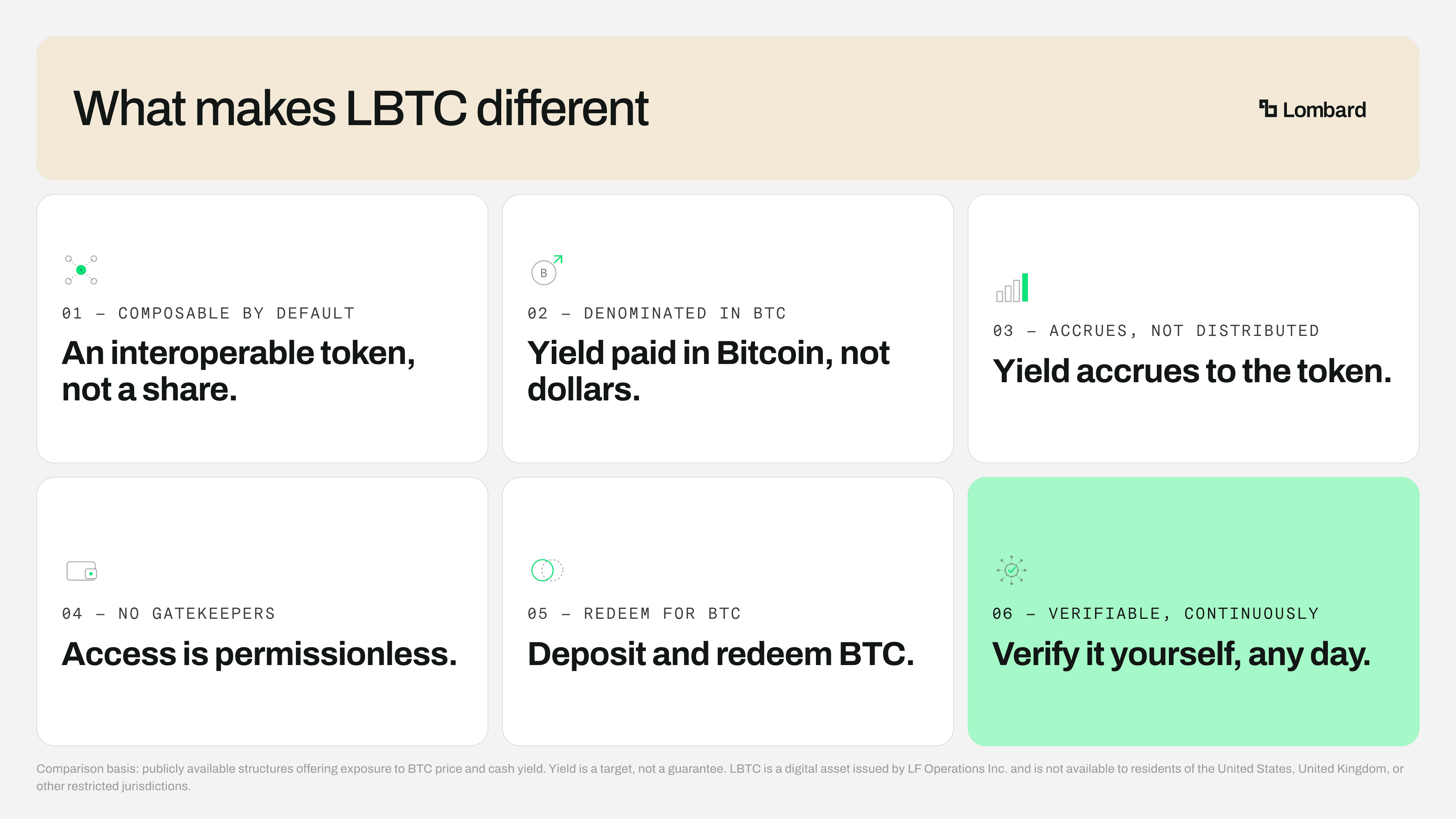 LBTC Differentiators-selection.png
It's a token, not a share. LBTC is a yield-bearing token, available on 11+ chains, and usable as collateral the moment it's minted across Aave, Morpho, Spark, and 50+ other DeFi protocols. A holder can borrow against it, deploy it in a vault, or stack additional yield on top of the strategy's own return. While an ETF share sits in a brokerage account, and nothing can be built on top of it.
The yield is paid in Bitcoin. Every fund in the table pays out in dollars, not Bitcoin. LBTC's yield is denominated in the asset the holder is trying to accumulate and hold. There's no second currency working against the first.
Yield accrues to the token, not as a monthly cheque. The four funds distribute cash monthly. LBTC's yield accrues through the appreciation of the token's backing value: nothing to reinvest, no cash sitting idle between distributions, no manual conversion back into Bitcoin to keep the position growing.
Access is permissionless. No brokerage or exchange account, no fund subscription, no minimum ticket size, no institutional relationship required. Holding LBTC requires a wallet, and access is restricted only by jurisdiction and sanctions screening. Every other product in the table is reachable in practice by a specific kind of investor, in a specific set of markets, through a specific intermediary.
LBTC is redeemable for BTC. Fund shares trade at a premium or discount to the assets behind them. LBTC redeems for BTC. What a holder owns and what backs it are the same number.
The strategy and backing is verifiable, continuously. Fund investors get periodic disclosures on a reporting schedule. LBTC holders can view the transparency page to verify deployment status, custody split, yield, and greeks exposure. View here.
To close
Six of the world's most sophisticated financial institutions looked at the problem of Bitcoin income and arrived at the same engine. The engine was never going to be the differentiator for long, mechanisms this good get copied. What doesn't get copied as easily is what LBTC hands back: a token, not a share; Bitcoin, not dollars; a wallet, not a brokerage account. Everyone converged on how to generate the yield. LBTC is the only one that lets a Bitcoin holder keep using Bitcoin while they earn it.
LBTC is a digital asset issued by LF Operations Inc., a Panama corporation (the "Issuer"). LBTC is not a bank deposit, money market fund, or other regulated deposit or investment product, is not insured or guaranteed by any government, deposit insurer, or other person, and is not covered by any investor or depositor protection scheme. Yield is variable, not guaranteed, and past, targeted, or indicative figures are not a reliable indicator of future yield. Digital assets involve a high degree of risk. Direct minting and redemption are not offered to Prohibited Persons. Nothing on this page is investment, legal, accounting, or tax advice, or a recommendation, offer, or solicitation. No fiduciary, advisory, or agency relationship is created between you and the Issuer or any of their respective affiliates. Your acquisition, holding, and use of LBTC are governed solely by the Lombard Terms of Use and LBTC Product Terms are subject to the risks described in the Risk Disclosures, which you are required to read and accept before using the Lombard Protocol.
NOTES & DISCLOSURES - PRO-FORMA NET PERFORMANCE (%) Source: Representative account** | Fee basis: Lombard MAA‡ | Returns in BTC termsˢ I Methodology: see b
ͣ Past performance is not necessarily indicative of future results, and there is no guarantee that the strategy will achieve its objectives or avoid substantial losses, including loss of principal. An investment in this strategy involves a high degree of risk. See "Bitwise Disclosures" below for additional information regarding risks. ** Performance for the period January 2022 - December 2025 reflects the track record of a predecessor strategy managed by Gordon Grant prior to joining Bitwise Asset Management. This performance was not achieved while managing assets at Bitwise. The strategy's investment mandate, process, and risk parameters are substantially similar to those employed at Bitwise. Performance from January 2026 onward reflects accounts managed by Bitwise Investment Manager, LLC. ✝ Performance shown is from a single representative account and is not a composite of all accounts managed under this strategy. Other accounts managed under the same strategy may have experienced different results due to differences in account size, timing, deployment levels, and other factors. The representative account was selected because it is believed to be representative of the performance of all reasonably comparable accounts for the periods shown; however, there can be no assurance that any other account has achieved or will achieve similar results. ‡ Net returns are presented on a pro-forma basis, calculated by deducting management fees and performance compensation at the rates applicable under the managed account agreement between LF (BVI) Ltd. and Bitwise Investment Manager, LLC from the representative account's gross returns. Pro-forma net returns do not reflect trading costs, custodial fees, or other operational expenses, which would further reduce returns. The fee rates used represent the most conservative (i.e., highest) tier under the applicable fee schedule. Pro-forma net returns are not the actual returns of any account and are provided for illustrative purposes only. Actual net returns of the Account will differ from those shown.
ˢ Returns are calculated based on the change in BTC in the account, not the dollar value of BTC holdings. A positive return in BTC terms may coincide with a negative return in USD terms.
ᵇ For the period beginning January 2026, monthly returns are calculated by dividing net performance by beginning-of-period net asset value. For the period January 2022-December 2025, monthly returns are calculated by dividing historical gross performance by beginning-of-period gross asset value, and then applying the relevant fee rate. The fee rate used represents the most conservative (i.e., highest) tier under the applicable fee schedule. Annual returns and YTD returns reflect the compounding of monthly returns. Returns do not reflect the reinvestment of income, as premium income remains within the account's BTC balance.
More from Research & Insights
View all →
LBTC Moves to Institutional Yield: Targeting 2.5% Net APY, Strategy Managed by Bitwise

Introducing Bitcoin Onchain Credit Strategy: A New Source of Bitcoin Yield from Institutional Credit