Product Guide: LBTC
A liquid-staked Bitcoin built by Lombard

LBTC is the most widely integrated liquid-staked Bitcoin asset in DeFi—built by Lombard to turn BTC from a passive store of value into productive, yield-generating capital. It earns yield by staking to Babylon’s Bitcoin Staking Network and is integrated across major DeFi protocols on EVM and non-EVM chains. This enables BTC to become active, composable capital.
LBTC currently powers over 70 protocols, including Aave, EigenLayer, Curve, Spark, and Symbiotic—leading the Bitcoin LST category by market share and onchain usage.
Bitcoin is the most important asset of our generation.
With a $2 trillion market cap and over 50% dominance of the crypto market, Bitcoin remains the most valuable digital asset. Yet less than $32 billion is active onchain—the majority remains idle in cold wallets or centralized exchanges.
Lombard’s LBTC unlocks onchain utility for Bitcoin. By enabling BTC staking and issuing a liquid, 1:1-backed derivative, LBTC transforms Bitcoin into a productive asset — one that earns yield and moves freely across DeFi. This marks a fundamental shift in Bitcoin’s role in financial markets: from passive store of value to active capital.
Get LBTC: https://www.lombard.finance/app/stake
Understanding Bitcoin Derivatives in DeFi
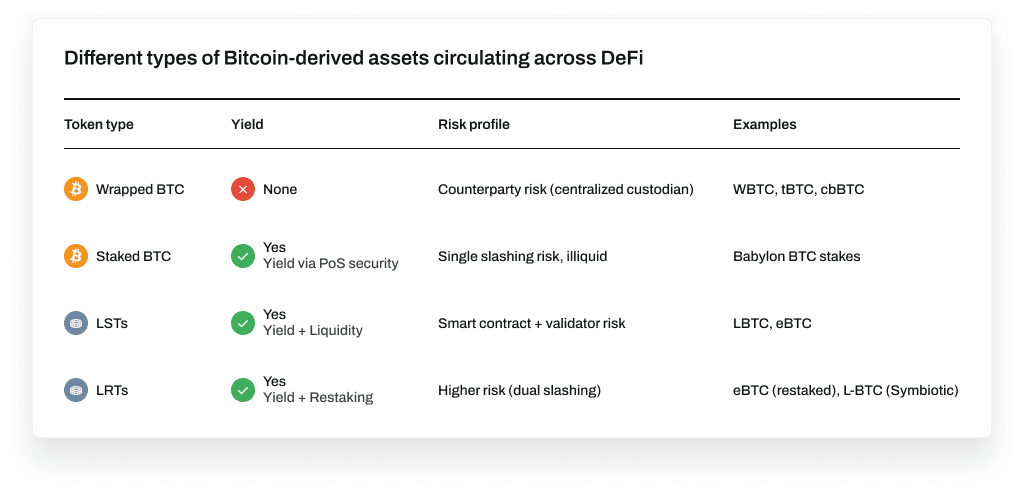
A growing number of Bitcoin-derived assets are emerging across DeFi, each with different tradeoffs in yield, liquidity, and risk:
 DeFi.png
LBTC stands apart. Fully backed by native Bitcoin and earning real staking yield via Babylon, LBTC sets a new standard for secure, liquid, and composable Bitcoin primitives.
Why LBTC Exists
If 25% of BTC moved onchain, over $540B in capital could be activated. Ethereum has reached over 27% staking participation, while Bitcoin is just getting started.
Until recently, Bitcoin lacked native programmability to support delegation, slashing, or validator coordination. Babylon’s Bitcoin Staking Protocol introduced a trust-minimized middleware that syncs with Bitcoin and enables secure delegation and slashing.
Today, the Bitcoin LST market has surpassed $5B, with LBTC representing ~$2B—approximately 40% of the category.
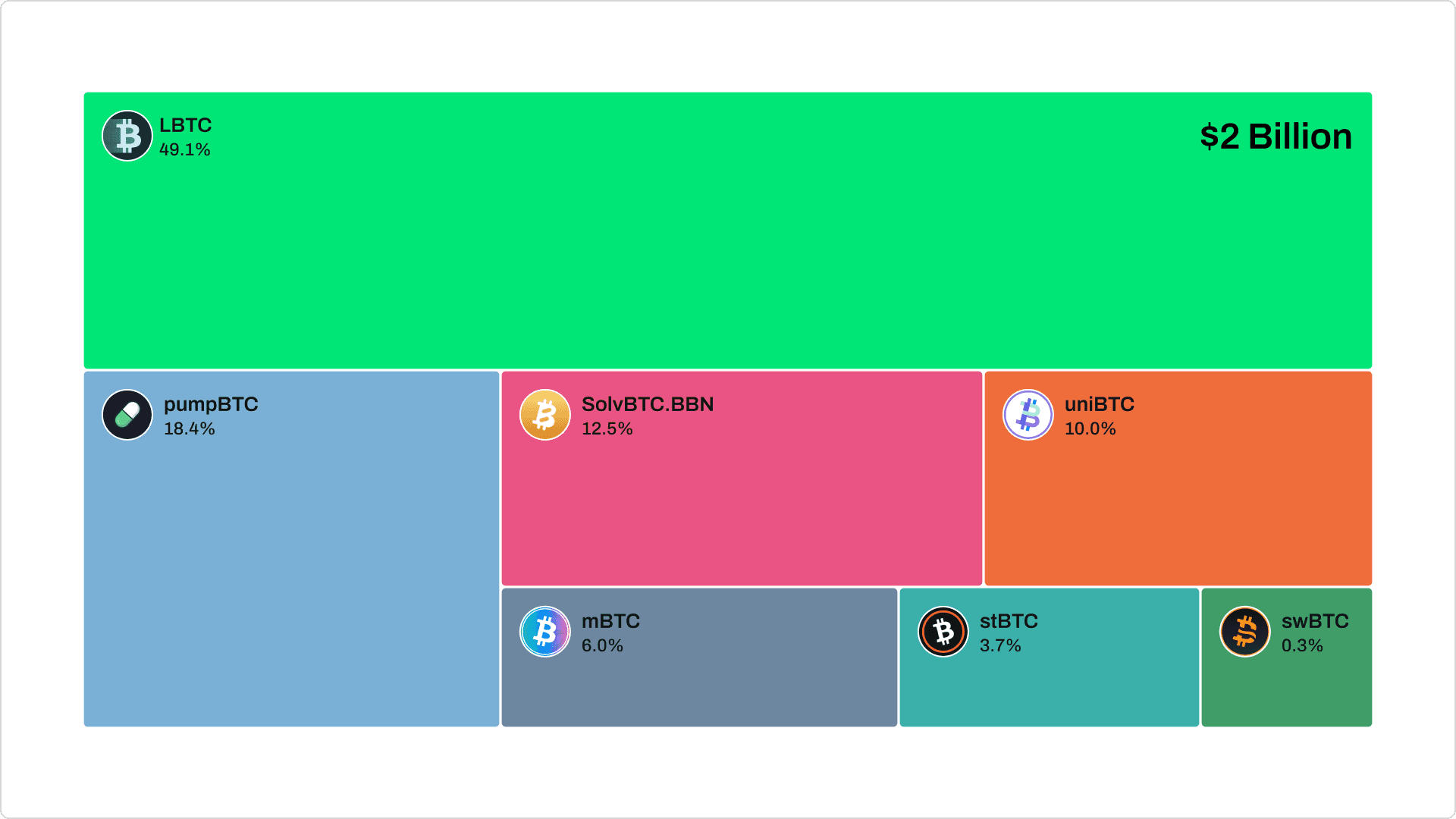 image.png
Who’s Using LBTC—And Why
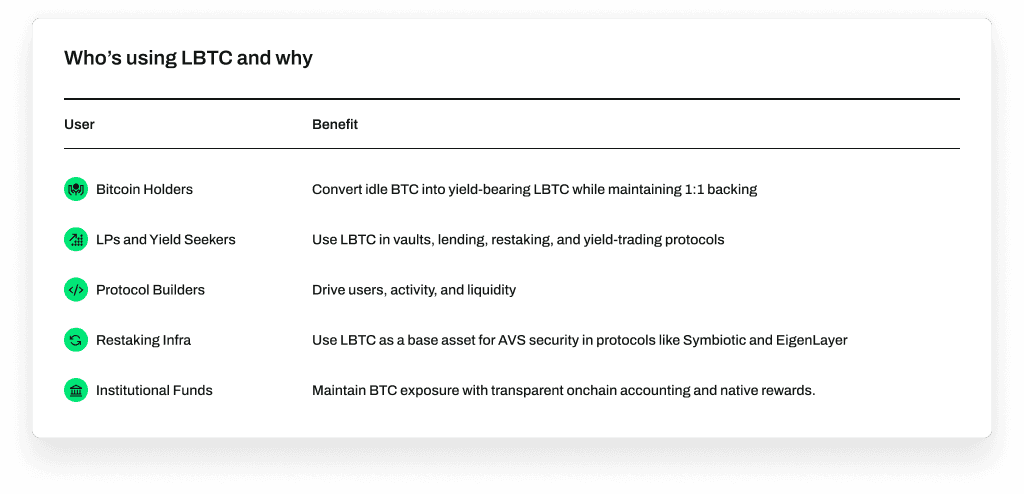
LBTC serves a diverse and growing ecosystem of users looking to activate Bitcoin onchain:
 Profile.png
LBTC enables capital efficiency without compromising decentralization.
How LBTC Generates Yield
BTC deposited into Lombard is staked via Babylon, earning yield for securing the Babylon Chain by providing finality and consesus on the blockchain, and soon other emerging Bitcoin-Secured Networks (BSNs) such as Osmosis, BOB, TAC, and others. These networks consume Bitcoin-based security while unlocking native rewards for stakers. Learn more about Babylon’s architecture and BSNs here.
Currently, LBTC rewards are claimable via the Staking Yield page in the Lombard App. In July, LBTC will transition into a truly yield-bearing asset—automatically accruing value and trading at a premium to BTC.
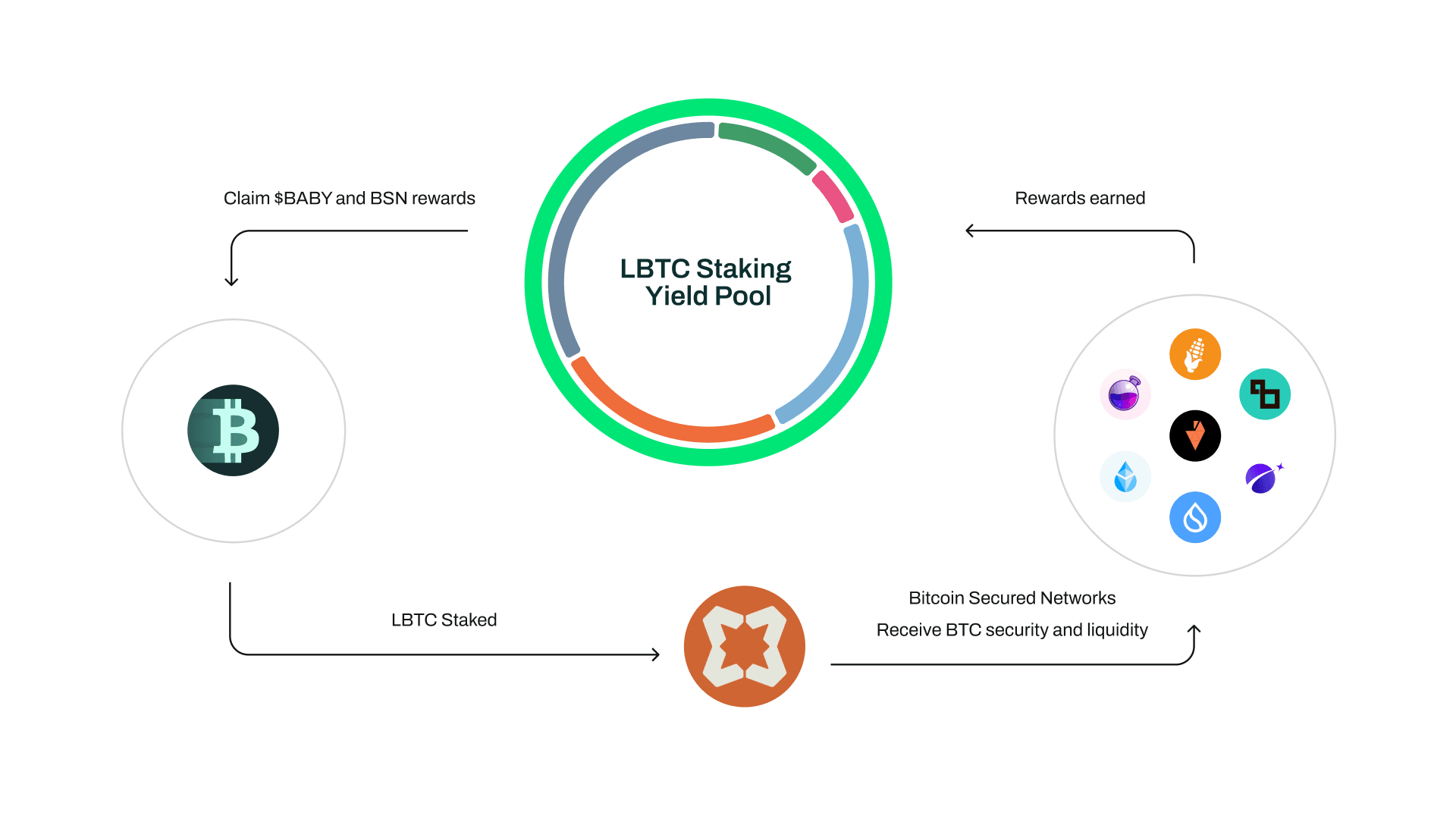 image-2.png
Visual: How LBTC accrues yield by securing BSNs
image-2.png
Visual: How LBTC accrues yield by securing BSNs
LBTC’s DeFi Dominance Across 70+ Protocols
Over 11,000 LBTC—more than 60% of supply—is deployed across 70+ DeFi protocols. Blue-chip protocols such as Aave, Spark, and Maple have onboarded LBTC following in-depth collateral assessments covering liquidity, volatility, and smart contract risk.
From lending markets and yield vaults to restaking and security provisioning, LBTC powers broad DeFi use cases:
Chart - Lombard Ecosystem
LBTC is fully composable, DeFi-integrated capital.
LBTC Security and Reliability
The Lombard Protocol and its associated products adhere to industry best practices and security standards designed to ensure resilience, transparency, and decentralization at every layer. These best practices span everything from onchain attestations and public audits to decentralized key management and incident response.
Security features include:
- Trust-minimized decentralized structure - A Security Consortium of 14 leading institutions including Galaxy, DCG, OKX, Wintermute, Amber, Antpool, F2pool validating every transaction on the protocol
- Hardware-isolated key storage with Cubist’s CubeSigner HSM
- Multi-factor checks and automated delayed withdrawals
- Pausability
- Audited by Cantina, Veridise, Halborn, Open Zeppelin, Sherlock
- An evergreen bug bounty program with Immunefi offering $250K to whitehat hackers, and runtime monitoring with Hexagate to protect the protocol 24/7.
- A proactive security response framework enables swift remediation in partnership with third-party experts.
Smart Contract Audits & Bug Bounties:
All Lombard code that goes into production is audited twice by leading auditors, as well as multiple reviews internally (Lombard has a full-time Security engineer). In addition, major releases undergo contest audits to battletest before release.
- The OpenZeppelin Consortium Report
- The Halborn Consortium report
- The Halborn smart contract report
- The Veridise smart contract report
- The Immunefi Bug Bounty Program ($250k)
- Immunefi Contest Audit
Transparency features include:
- Publicly auditable mint/burn logs
- Real-time Proof-of-Reserves oracle
- Onchain stake attestations providing real-time attestations
Cross-Chain Security and Price Reliability
LBTC is natively issued on Ethereum, Base, Sui, Sonic, and BNB Chain via Chainlink CCIP, ensuring secure bridging across supported chains. Every transaction requires being approved by both CCIP validators and the Lombard Security Consortium, reducing the risk of unauthorized minting.
Lombard is the first BTC LST to implement a proof-of-reserves oracle built in collaboration with Redstone & Chainlink. Lombard’s reserves are viewable in real-time on our proof of reserves page. PoR oracle provides crucial transparency and reassurance in the solvency of Lombard’s BTC balances, consequently disincentivizing LBTC liquidations below redemption value and further strengthening the peg.
Lastly, Lombard has implemented multiple layers of active monitoring to detect malicious activities, with independent invariant checks (Cubist Bascule), automated pausing capabilities (via Hexagate) and incident response via PagerDuty.
How LBTC Works: Stake → Mint → Deploy
LBTC allows native Bitcoin to be staked and converted into a liquid, yield-generating asset usable across DeFi. The process is simple:
- Stake BTC via the Lombard App
- Mint LBTC
- Deploy LBTC across DeFi protocols, such as the Lombard DeFi Vault
- Unstake LBTC to redeem native BTC and claim accrued rewards
LBTC is always fully collateralized by native Bitcoin held securely and transparently within the protocol. For implementation details, refer to the technical documentation.