

Lombard Introduces Bitcoin Smart Accounts: The First Rail Between Institutional Custody and Onchain Finance
February 11, 2026
8 minutes read


Lombard today announced the development of Bitcoin Smart Accounts, the first rail between institutional custody and onchain finance. This breakthrough infrastructure recognizes BTC held in institutional custody—qualified custody, MPC, or a self-custody wallet—as onchain collateral, enabling the world’s largest institutions and individuals to use their BTC productively on lending markets, liquidity venues, and decentralized exchanges, without transferring custody or control of the underlying BTC to any third party.
The Breakthrough
Every financial breakthrough looks the same from the outside. It doesn't create new money, it connects two ecosystems that were previously isolated, and in doing so, unlocks $trillions.
ACH connected US banks to each other. SWIFT connected banks across borders. Fedwire gave the Federal Reserve's member banks a shared settlement layer. None of these systems moved physical assets, they moved instructions, and created the permission to settle. And in doing so, they made entire categories of economic activity possible that simply did not exist before.
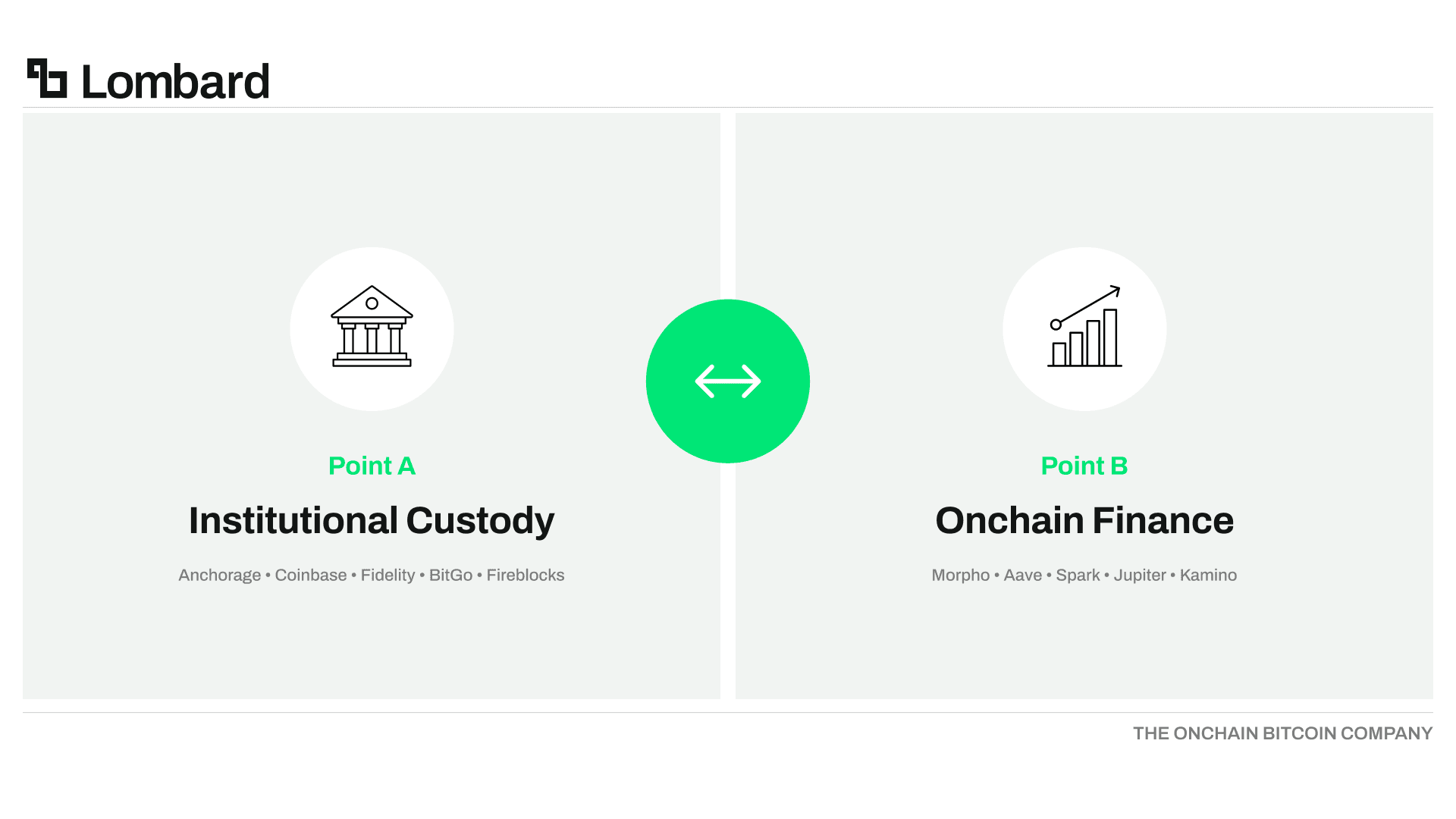
Lombard’s rail applies the same principle to Bitcoin, creating a global, permissionless settlement network between two previously isolated ecosystems; institutional custody and onchain finance. BTC held in any custody environment—qualified custody, MPC, or self-custody wallet—can now enter whitelisted onchain markets without asset movement. Bitcoin holders access it through a Bitcoin Smart Account with their existing custody set up.
At launch in Q1 2026, the product will be made available to Lombard’s private clients through select qualified custodians, allowing access to leading lending infrastructure Morpho. Lombard plans to expand the network of custodians and whitelisted protocols in 2026, opening onchain markets to hundreds of billions of dollars in custodied Bitcoin.

Two worlds. No connection.
For over a decade, Bitcoin has existed in two worlds that have never been properly connected.
The first is institutional custody. This is where the serious institutional money lives; Anchorage Digital, BitGo, Fidelity and Fireblocks. These custodians represent the most battle-tested custody tech for BTC and many other digital assets, and an estimated $500 billion in BTC currently sits in qualified custody.
The second is onchain finance. Decentralized lending protocols offer transparent, collateralized borrowing, often meaningfully cheaper than offchain options, with no counterparty risk. DeFi protocols like Aave, Morpho, Spark, Jupiter, and Kamino enable capital efficiency in ways traditional finance cannot match.
Until now, Bitcoin holders faced an impossible choice: keep your BTC in cold storage and accept zero utility, or move it onchain and accept bridge and smart contract risk.
If you held BTC at a qualified custodian and sought liquidity against it, you had three unattractive options:
1. Exit custody — losing institutional insurance and introducing bridge and smart contract risk.
2. Use an OTC lender— less competitive borrowing rates, accepting opaque terms, hidden spreads, and settlement measured in days.
3. Sell Bitcoin — triggering a tax event and losing upside potential.
It’s clear that Bitcoin is going institutional, but infrastructure hasn’t kept pace.
How Bitcoin Smart Accounts Work
Bitcoin holders access onchain finance through a Bitcoin Smart Account with their existing custody set-up, where BTC held in custody is recognized as collateral.
Key Benefits:
- No Transfer of Title — Full legal title and beneficial ownership stay with you at all times, with complete asset isolation per account. No pooling, no rehypothecation, no counterparty risk.
- Bitcoin never leaves custody — BTC remains in your existing custody set-up (self-custody wallet or with your qualified custodian) throughout the entire process so you maintain the same security and protections
- Access to Onchain Yields and Borrowing — Earn the best risk-adjusted yield, and borrow at below market rates by utilizing one of many smart-contract-based financial applications.
- Manage positions in real-time — Borrow, repay, and adjust collateral at any time without the approval of any third party, with full onchain transparency
Bitcoin Smart Accounts enable collateral recognition, without asset movement.
"For 17 years, institutions that hold BTC could have either the security of top custodians or onchain utility—never both. Bitcoin Smart Accounts are how institutional capital accesses onchain finance, without trade-offs, transforming Bitcoin from a passive asset into usable capital while maintaining existing trusted custody set-ups."
A corporate treasury holding BTC at a leading custodian can now deploy those assets onchain to earn yield, or borrow stablecoins (and much more) without moving the asset, losing title rights, selling Bitcoin, triggering tax events, or introducing bridging and smart contract risks.
The Process
- Add a Bitcoin Smart Account designation to your existing custody account The account automatically recognizes the BTC and issues a receipt token — BTC.b
- From the same account Borrow stablecoins from a top lending protocol at the advertised LTV and APR. Access yield opportunities on future whitelisted protocols.
- Manage your position — Borrow, repay, and adjust collateral at any time with full onchain transparency
- Unlock anytime — Unlock Bitcoin without third-party approval whenever you choose
Custody integrity. Onchain utility. No trade-off.
Built For Institutional Bitcoin Capital
The infrastructure is designed for individuals and institutions including:
- Asset managers and crypto funds seeking to generate yield through curated DeFi strategies
- Corporate treasuries wanting to access working capital without selling balance sheet Bitcoin
- High-net-worth individuals requiring liquidity without tax events or custody compromise
“Through this integration, Lombard leverages Morpho as the lending infrastructure, enabling Bitcoin held in professional custody to be used productively onchain and unlocking institutional Bitcoin” said Paul Frambot, Co-founder and CEO of Morpho. “This is exactly the kind of institutional-grade use case Morpho was built for: connecting real-world custody setups to open, permissionless lending markets at scale.”
The Bitcoin Smart Account System Design
Bitcoin Smart Accounts do not ask Bitcoin holders to trust something new. It asks them to trust what they already trust, and connects it. Bitcoin Smart Accounts rely upon foundational technologies; Bitcoin's 17-year consensus history, Ethereum's track record, and existing key management practices within existing custody set-ups.
The Bitcoin Smart Accounts architecture minimizes trust by involving custodians in the validation of Bitcoin locks. This is achieved through the use of battle-tested Bitcoin primitives, including partially signed Bitcoin transactions (PSBTs) and time locks to form emulated covenants, which are the backbone for establishing programmable locking functionality on the Bitcoin network.
This is not a vault. It is not a liquid staking token. It is a layer that sits between custody and onchain finance and makes both more valuable.
Impact and Availability
Bitcoin Smart Accounts will expand the addressable pool of Bitcoin that can participate onchain and create pathways to vaults and structured strategies over time. The architecture is custody-agnostic — qualified custody, MPC, self-custody wallets — if the Bitcoin is there, the rail will connect it.
For Bitcoin holders: Plug into onchain opportunities through a custody set-up you already trust, and use that access again and again. The rail is a gateway, not a one-off transaction.
For Builders: Introduce net-new offerings to existing clients without rebuilding Bitcoin infrastructure or moving assets off-platform. Integrate once, and the economics — fees embedded directly into yield and borrow flows — scale with usage. The DeFi Mullet for Bitcoin just got much more attractive.
Until now, institutional access to DeFi has been hindered by bespoke legal, operational, and risk processes — each one built from scratch, each one non-repeatable. Bitcoin Smart Accounts package that access into a single, governed product. Approve it once. Reuse it at scale.
Rails don't derive their value from the transactions they process on day one. They derive it from the network they create — and the compounding number of participants who build on top of them over time. ACH started with a handful of US banks. Today it processes over 30 billion transactions a year. SWIFT started with 239 banks across 15 countries. Today it connects over 11,000 financial institutions across 200 countries.
Lombard plans to expand the network of custodians and whitelisted protocols throughout 2026 — opening onchain markets to hundreds of billions of dollars in custodied Bitcoin.
Bitcoin Smart Accounts are currently live in pilot with select clients of leading custodians. Public availability is expected in Q1 2026. Clients interested in pilot participation can contact Lombard's institutional team at institutional@lombard.finance.
About Lombard
Lombard is an onchain Bitcoin company, issuing institutional-grade Bitcoin assets, onchain financial solutions and core infrastructure. Founded in 2024, the company's products—including LBTC, the leading yield-bearing Bitcoin, BTC.b, the Lombard SDK, and Bitcoin Smart Accounts—enable Bitcoin to become productive capital across decentralized finance.
About Morpho
Morpho is an onchain lending network with $10B+ in deposits connecting lenders and borrowers to the optimal opportunities worldwide. Businesses can utilize Morpho's open infrastructure to power any lending or borrowing use case at scale, including embedded crypto-backed loans, custom yield solutions, and vault curation. Morpho serves as the backend powering innovative financial institutions and enabling leaders like Coinbase, Bitwise Asset Management, and Société Generale to deploy secure, scalable, and custom onchain strategies. For more information, please visit Morpho.org.